
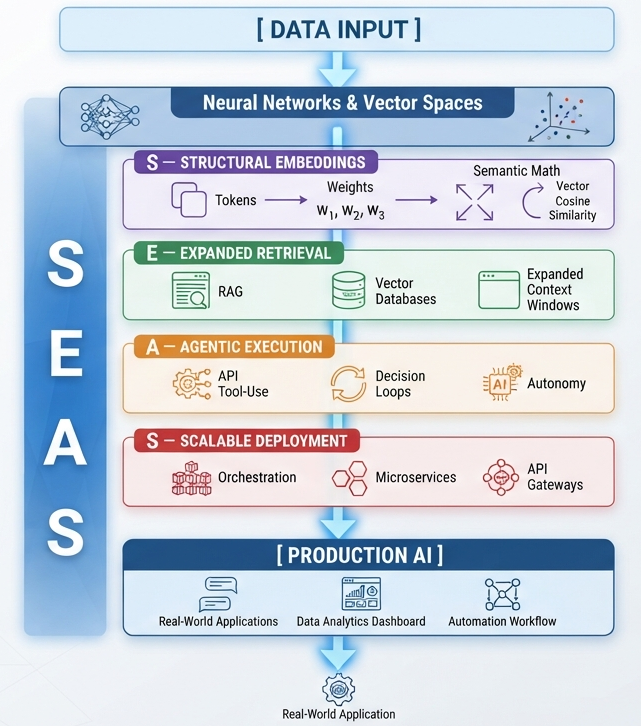
Seven SEAS
A practical architecture model for enterprise-grade AI systems. Seven SEAS bridges foundation-model theory and production implementation through a clear engineering path from data ingestion to real-world deployment.
Books
Enterprise AI Architecture Framework
A practical architecture model for enterprise-grade AI systems. Seven SEAS bridges foundation-model theory and production implementation through a clear engineering path from data ingestion to real-world deployment.

Master the seven technical pillars every production-grade agentic system must adopt: State & Memory, Tool Calls, Execution Loops, RAG Grounding, Multi-Agent Collaboration, Guardrails, and Observability.
Chapter Index
Modern agents require tiered memory architecture that mirrors human cognition: short-term working memory, episodic memory, and semantic memory.
Enterprise reliability depends on strict schemas that bridge probabilistic model output with deterministic API execution.
True agents plan, execute, evaluate outcomes, and adapt strategies when intermediate steps fail.
Production systems must retrieve factual, context-specific data in real time to reduce hallucinations.
Complex systems perform best when specialized agents collaborate through structured delegation.
Autonomous systems require robust security and policy boundaries before any sensitive action is executed.
Because agent execution is non-deterministic, deep tracing and eval-driven development are mandatory.